Today we reviewed all contracts awarded by the Defense Logistics Agency (DLA) for the month of February 2019 to see what trends might appear. Contractors selling Commercial Hardware (CH) items were third from the top of the list, by percentage of contracts. The Commercial Hardware category is diverse both in types of items as well as government contractors supplying them. Nearly every Ship, Submarine, Aircraft, Vehicle, System or Facility has parts categorized under the Commercial Hardware category it’s NOT just things you find in your big box store”.
The Commercial Hardware category consists of over 350
subcategories. Companies looking to
start selling to DOD or wishing to increase their DOD sales should take a
serious look at this category, especially when searching for government solicitations.
Over ten (10) percent of all the contracts
awarded in total by the Defense Logistics Agency (DLA) for the month of February
(as of today) have been awarded to over 400 companies selling products
categorized as Commercial Hardware.
What is Commercial Hardware? First of all it doesn’t include Screws, Nuts, Bolts, or Washers, they have their own categories. Commercial Hardware items are produced by all types of industries such as Machine shops, Fabricators and Assembly shops made from various materials like metals, plastics and rubbers.
Here is a small sampling, a few names of products found within the subcategories under Commercial Hardware:
When searching for government solicitations for commercial hardware items it can be cumbersome and time consuming due to the fact that this category has over 350 subcategories. The trick is to search by the individual item name(s) for a more refined result set. In fact after searching for open government solicitations in BidLink today we found 1,500 open bids for commercial hardware items.
In conclusion if you are interested in increasing the
number of government contracts you win take a look at the category “Commercial
Hardware”. No matter what your specialty
is the chances of finding something you can supply to DLA is fairly good under
this category. Also looking at the procurement
history of past government contracts shows that small businesses succeed in
this category.
BidLink is a provider of DOD procurement research tools and has been a leading provider of industry marketing data relating to DOD procurement and solicitations for the past 20 years. Find defense contracts and research competition. Learn more at www.bidlink.net
How much chocolate does the Department of Defense (DOD)
buy, one of our staff said on Valentine’s Day. The Defense Department buys chocolate you say?
Yes DOD buys everything from weapon systems
to food and candy, you just need to know where and how to look.
If you are looking to sell to DOD or wondering how, your answers
exist in the data.
Reviewing past contract awards and solicitations tell you
details of the purchase. The answers you’ll
find through this type of review will help guide you on how to sell your products. Finding answers such as who’s buying that
type of item, how they are buying it, what kind of contract(s) are used how many
are purchased and what price they are paying.
These answers will guide you on the best way to sell. If you are simply just searching for open solicitations,
you could be missing out on other business opportunities.
DOD buys all kinds of food including fresh fruits and vegetables, dairy, bakery products and candy including chocolate. Various types of contracts are used; both large and small companies sell food to DOD. Contracts for food are awarded to local vendors as well as large prime vendors. Contracts can be long term or one time buys. The successful government contractor uses all these methods.
The first part of my market research was to determine the code(s) relating to chocolate products. There isn’t one but there is class of items under FSC 8925 which is titled “Sugar, Confectionery, and Nuts” – candy, chewing gum, honey and maple syrup all fall under that category. Since chocolate is a candy now I know to search using FSC 8925 to find contracts and solicitations that might contain chocolate.
Then I looked for contracts, companies selling products
under FSC 8925, bounced around in BidLink looking up contracts, companies, NSNs’
Cage Codes finding some very specific results of companies selling chocolate.
My goal for this study to just get an idea of what kind
of chocolate was sold and who sold it in past 45 days starting January 1st
2019 till today.
A few data points I found relating to Chocolate the
Defense Logistic Agency (DLA) is buying:
Both Sweet and Semisweet chocolate baking chips, various types
Chocolate covered peanuts, assorted colors – Any guesses on the manufacturer?
Most contracts awarded to medium/large companies but one was
small with less than 40 employees.
Although I do not have the total picture of what’s being sold or what they might have purchased for Valentine’s Day, I did prove that DOD buys chocolate. This conclusion can possibly lead you or your company to successful sales of you own to DOD.
BidLink is a provider of DOD procurement research tools and has been a leading provider of industry marketing data relating to DOD procurement and solicitations for the past 20 years. Find defense contracts and research competition. Learn more at www.bidlink.net
When searching for DOD Bids for Electrical Equipment, Wiring Supplies, and Related Equipment, are you using the right codes?
One way companies find Government Contracting Opportunities is by the use of North American Industry Classification System (NAICS) codes. NAICS Industry code 423610 is defined as “Wholesalers of Electrical Apparatus and Equipment, Wiring Supplies, and Related Equipment”. Over 6,000 companies currently list this code in their SAM.gov registration, in the hope of finding government business. Your SAM.gov profile defines your business and capabilities to the Federal Government.
When a new SAM.gov registrant sets up its profile, it usually reviews NAICS codes to choose the one(s) that most closely represent their business. All of the following items are included in NAICS 423610:
NAICS Industry Item List for Code 423610
Alarms Batteries (except automotive) Electrical Boxes and fittings Busbars and trolley ducts Capacitors (except electronic) Circuit breakers Coaxial cable Electric wire and cable conduit Electrical conduits and raceways Electrical connectors Electrical construction materials Current-carrying wiring devices Electrical distribution equipment Electric light fixtures Electric motors Electric prime movers Electrical apparatus Electrical fastening devices, Electrical fittings Flashlights Fuses Electrical generators Electrical hanging devices Hardware, transmission pole and line Electrical industrial controls Electrical measuring Instruments Insulated wire or cable Electrical insulators Light bulbs Electrical lighting fixtures Lightning arrestors Electrical Lugs and connectors Electrical meters Electric motor controls Motors, electric Panelboards, electric power distribution Pole line hardware Electrical power transmission equipment Electrical receptacles Voltage regulators Relays Security systems Signal systems and devices Storage batteries (except automotive) Electrical distribution switchboards Electrical switches Electrical transformers Electrical transmission equipment Electrical unit substations Insulated Wire Wiring supplies
If you sell any of the items listed above you’ve probably used this NAICS 423610 in your search for government solicitations. However, looking for solicitations with this code will provide poor results.
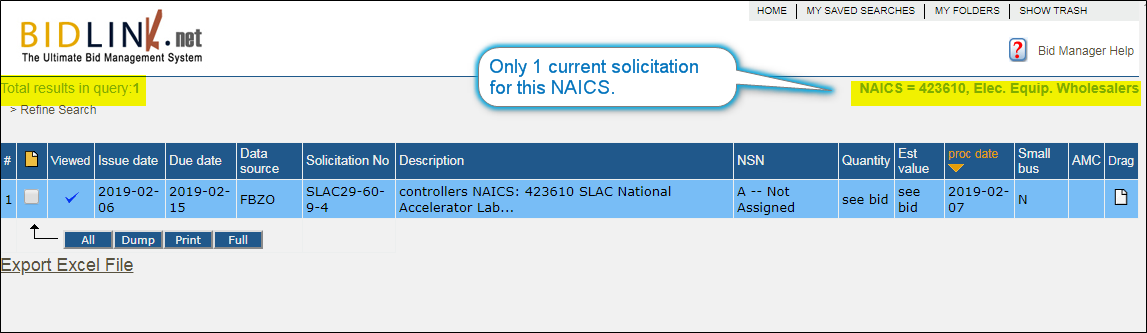
Here’s why – NAICS code 423610 is not typically used by DoD when it creates solicitations for electrical equipment. When we searched in BidLink.net for open solicitations under this NAICS code, this is all we got:
(click on image to enlarge)
To get good results use Federal Supply Classes (FSC’s) in your searches. Try setting up a solicitation search at www.bidlink.net, or at a government site to see the difference. A search with NAICS code 423610 will show very few solicitations, whereas searching with codes like FSC 5935 (the FSC for “Electrical Connectors”) returns more more fruitful results:
(click on image to enlarge)
BidLink is a provider of DoD procurement research tools and has been a leading provider of industry marketing data relating to DoD procurement and solicitations for the past 20 years. Find defense contracts and research competition. Learn more at www.bidlink.net.
Understanding and screening solicitations for their Acquisition Method Code (AMC) and Acquisition Method Suffix Code (AMSC) is important because it quickly reveals if your company is eligible to bid on the solicitation and indicates special technical characteristics of the item. So, by correctly interpreting the item’s AMC / AMSC you’ll know right-off-the-bat if you should even consider the solicitation.
What AMC / AMSC Mean
DoD buyers use AMC/AMSC when they create solicitations. Each National Stock Number (NSN) has its own AMC/AMSC. The unique two place code describes (a) the part’s level of “acquisition competitiveness” and, (b) the availability of supporting technical data. A part’s AMC/AMSC often changes over time leading to greater opportunities for suppliers.
We’ll look at each code separately and then explain how to use them advantageously.
AMC – Acquisition Method Code is single digit code that describes the type of supplier eligible to supply the part. One of the following six numbers will appear (what each code means to the buyer is also defined here):
1 – Acquire the part competitively.
2 – Acquire the part competitively for first time (similar to 1).
3 – Acquire the part directly from its manufacturer, only.
4 – Acquire the part directly from its manufacturer only, for the first time. (similar to 3).
5 – Acquire the part directly from its prime contractor only (aka “sole source”).
0 – The part was not assigned AMC 1 – 5.
Some conclusions:
Resellers of every kind will be interested in solicitations with AMC 1 & 2; but resellers who are not Original Equipment Manufacturers (OEMs) will be disqualified from bids for parts with AMC 3 & 4.
OEMs want to further evaluate solicitations with AMC 3 & 4 that they can manufacture.
Resellers and OEMs may be interested in contacting the prime contractor for solicitations with AMC 5 to see if they can provide the part directly to the prime, as a subcontractor.
AMSC – Acquisition Method Suffix Code is a supplementary code that further explains the preceding AMC code. There are 19 AMSCs, many describing only fine differences in an item’s technical characteristics and/or the availability of technical data to support the item’s acquisition. We’ve simplified the grouping of AMSCs to suggest how you might wish to think about them, as follows:
Unconstrained Procurement (no significant barriers to acquisition) – A,
G, Z
Restrictions on source of supply (i.e. the item is source controlled, QPL, limited to existing sources, has special technical characteristics, there is insufficient data with which to source from new supplier, etc.) – B, C, D, H, K, L, M, N, P, Q, R, S, T, U, V, Y
Some Conclusions:
New opportunities are often found with AMSC “G” which signifies, “The Government has unlimited rights to the technical data, and the data package is complete.” New suppliers may still have to pass first article testing.
Even though a part has a restrictive AMSC code, it can be worth considering. For example, suppliers experienced with similar parts to the one being procured may be able to “reverse-engineer” the required part. The prospective supplier can then either contact the government buyer to ascertain the feasibility of second-source procurement, or supply it to the current source of supply.
Examples of Code Combinations Indicating Competitive Opportunities1G & 2G – Competitive with drawings available.
1T & 2T – Competitive but controlled by Qualified Products List (QPL). There are more opportunities here than you might realize. We’ll explain why active suppliers should be tracking these code combinations and how they can get on the QPLs and supply these parts, in Part 2 of this article.
1L & 2L – Competitive and the annual buy value of this part is < $10,000.
1Z & 2Z – Competitive and the part is considered a Commercial-Off-The-Shelf (COTS) item.
Unfortunately, AMC/AMSC codes are not usually listed in either the solicitation documents or on government websites such as FBO FedBizOpps (FBO) or DLA Internet Bid Board System (DIBBS). Rather, DoD will include in solicitation documents a statement like “full and open competition,” and will list the applicable drawing(s) and technical data in the government’s possession (note that this information infers that an AMC/AMSC “1G” or “2G” applies). To find this out, you’ll have to read through the solicitation document (see the following sample page). If you review multiple DoD solicitations for bidding opportunities, reading through all this information will take a very long time.
No AMC here
(click on image to enlarge)BidLink Streamlines Searches by AMC/AMSCBidLink does provide the AMC/AMSC for parts in DoD solicitations AND allows you to filter solicitations by AMC/AMSC code.
For example, let’s say that you wish to see all current solicitations with “1G” and “2G” AMC/AMSC. In BidLink.net you can easily generate a list of all current competitive solicitations, like this one:
AMC “1G” & “2G”
(click on image to enlarge)BidLink.net also provides multiple filters, so you can further refine your search:
AMC “1G” & “2G” filtered for aircraft parts
(click on image to enlarge)BidLink.net provides a user-friendly interface, designed to improve the efficiency and productivity of your government solicitations search and bidding workflow.
To learn more about BidLink.net, and to try it for free, click here >>BidLink.net FREE TRIAL.
If you found this article interesting, check this out >> BidLink.net — Better than DIBBSWin more defense contracts with BidLinkTweet
Every day the Defense Logistic Agency (DLA) creates thousands purchase requests for items they buy on a regular basis. DLA is the prime buying activity for any item such as sustainment or spare parts that support the troops or any of the thousands of systems used throughout Military and Federal Government agencies.
While the Federal Government shutdown 2019 continues (as of January 15, 2019) the Department of Defense (DoD) continues to remain in operation awarding thousands of Government Contracts and issuing Government Solicitations every day.
The top three manufacturers (by number of solicitations) posted by DLA today are SPS Technologies and Oshkosh Corporation. Yes that’s only two companies; SPS Technologies has both the 1st and 3rd place position. SPS Technologies is a manufacturer of fasteners and Oshkosh Corporation makes trucks and vehicle parts, DLA buys a lot of both.
These open government solicitations cover a variety of items. The fasteners are things like Rivets, Screws, and Bolts. The automotive parts cover items such as Vehicle heaters, Cylinder assemblies, Bushings, Cable assemblies and parts kits to name a few.
Government Solicitations typically list the officially accepted manufacturer and/or offer opportunities for new manufacturers to become “New Qualified Sources” through a source approval process.
Selling to the DoD can provide government contractors a virtually endless stream of government bid opportunities covering all types of items.
BidLink is a provider of DoD procurement research tools and has been a leading provider of industry marketing data relating to DoD procurement and solicitations for the past 19 years. Find defense contracts and research competition. Learn more at www.bidlink.net
There must be an easier way !
In this post we’re going to quickly show you how BidLink makes it MUCH easier to find and bid the government solicitations that YOU’RE LOOKING FOR.
Anyone who’s worked with DIBBS (DLABid Board System) knows how frustrating it is to find government solicitations and RFQs that match your particular business.
Let’s say that you’re a distributor or reseller of “Mil-Spec” connectors, specializing in the following series…
MIL-DTL-38999
MIL-DTL-26482
MIL-DTL-24308
…and you want to review the current open solicitations from DoD and DLA for these connectors.
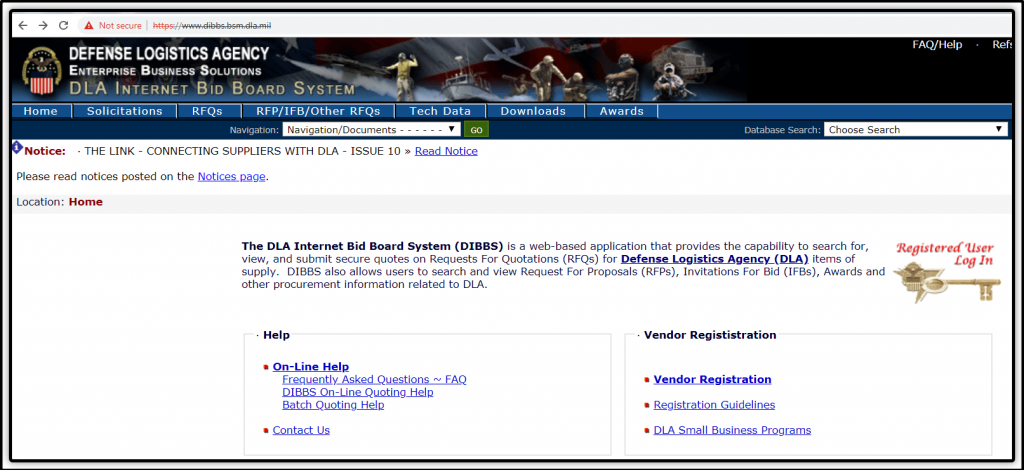
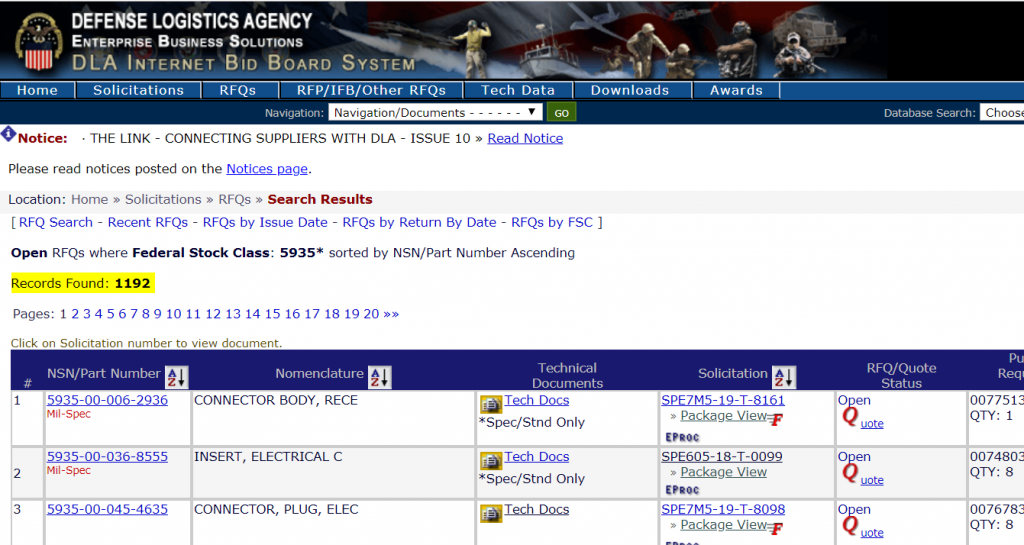
You can go to the DIBBS and look for all open solicitations for FSC (Federal Supply Class) 5935 (“Connectors, Electrical”) and you’ll get this….
TMI…. 1,192 records that you can slog through to find the ones that you might wish to bid on — what else do you have to this week?
Of course, DIBBS provides other search functions and parameters that you might use to narrow down your search.
Let’s see what results we get:
Obviously, DIBBS is not the place that you want to be spending your valuable time finding and researching government solicitations that you can bid on.
May we suggest that you search for government business on BidLink?
Here’s what you would, quickly find….
Ahhh, that’s better.
(click to enlarge)
….A user-friendly interface, created solely to improve the efficiency and productivity of your government solicitations search and bidding activity.
To learn more about BidLink.net, and to try it for free, click here >> BidLink.net Free Trial
If you found this article interesting and would like to read another, we recommend this one >> DoD Procurement; Acquisition Method Codes (Part 1)
*Above DIBBS and BidLlink.net search results current to 16:30 ET, 12/19/2018.
Free Trial for BidLinkTweet
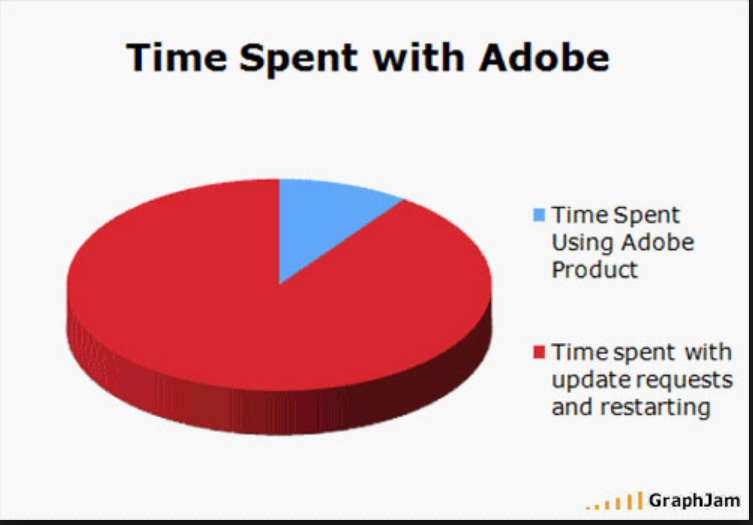
On November 20, 2018, the Defense Department switched their document generation system to use an antiquated document format called Dynamic XFA (XML Forms Architecture). XFA is not part of the PDF standard. It was included in Adobe LiveCycle in 2002 when the company acquired Canadian service provider Accelio, who was using XFA. This produced confusion as Adobe already had its own way of handling forms called AcroForms.
Adobe announced the discontinuation of the Dynamic XFA format in 2011. It is not part of the PDF 2.0 standard and is not included in their latest PDF creation tools.
This has been causing havoc all over DOD and the private sector as people have been unable to open many military documents with anything other than Adobe Acrobat Software. Attempting to open these files in the web browser produces this message:
“To view the full contents of this document, you need a later version of the PDF viewer. You can upgrade to the latest version of Adobe Reader from www.adobe.com/products/acrobat/readstep2.html
For further support, go to www.adobe.com/support/products/acrreader.html”
This change affects documents from DIBBS, a primary source of solicitations and awards for the defense department. After receiving many complaints from end-users about the format change, DIBBS released this statement:
Some suppliers have commented that they cannot open the solicitation and/or awards on DIBBS. This is not an issue with DIBBS, but your browser settings when it comes to Adobe. The following links are provided that can assist and properly setting your computer to read Acrobat Adobe documents. A way of testing this being the issue, if you can download the PDF to your local PC and then open it, then you need to update the plug-in in your browser.
Unfortunately, this doesn’t help people who want to view the documents in a web browser instead of opening the bloated Adobe Acrobat program. It also doesn’t help people using Macintosh or anyone who wants to open these documents on an iPad, iPhone or Android. Shortly afterward, DIBBS began receiving complaints that their full-text search was not working. This is likely because their own system is unable to convert these Dynamic XFA documents into something that can be searched. When reaching out to DIBBS about the issue we received this response:
We did switch to another format due to security. This may be affecting the text search. The Tech Teams are still working to solve this. We were unaware of the original switch and have not been informed as to the solution to this yet.
The DIBBS Team
Its obvious that they have discovered the huge mistake and are attempting to resolve it. We anticipate that they will migrate to a standardized PDF format which would resolve the above issue. In the meantime, contractors are dealing with the inconvenience of trying to open these obscure files.
Because the format is obsolete, there are very few tools that can work with it. At BidLink, we have explored over a dozen different tools to potentially convert these files into normal, flat PDF files. So far, none of these tools produce an acceptable result. We will continue to look for solutions, but are hopeful that DOD will simply abandon Dynamic XFA entirely.
Over the past 18 years manufacturers have contacted us at BidLink asking questions such as:
How can I increase my sales to the Department of Defense (DoD)?
Does DoD currently buy the type of products I can produce? Answer is Yes
If you are a manufacture, DoD may already be purchasing your products and you don’t know it. Currently there are over 600,000 vendors registered to sell to DoD. Many of these vendors are brokers, mass distributors or resellers selling products produced by 1000’s of manufacturers. Unless you are receiving reports from every vendor that sells to DoD it may be a mystery on which manufacturers products are actually being purchased.
Manufacturers selling direct to DoD typically know what was sold at least for their product. Whereas the manufacturer selling using other methods such as mass distributors, resellers or brokers may not know exactly what was sold or how much it sold for. Most manufacturers especially ones selling through mass distributors do not usually know what their competitors are selling to DoD. Time spend researching this will benefit your company in many ways possibly increasing your product line.
How do I research sales of my products/competitors?
In case you are thinking DoD only buys complex systems, think again. DoD buys tons of non-specialty items everyday as well. These are the type of items you might find in a catalog or online and they are commonly known as a Commercial Off The Shelf (COTS).
DoD buys millions of these COTS every year from both manufacturers and resellers. If you are a manufacturer the chances are pretty good that DoD is buying one of your competitors products that does exactly what your product does. It will take some time and research but the rewards can be good.
Free Trial for BidLink
How do I research and look for products I could make?
DoD has a catalog of NSNs consisting of items they purchase on a regular basis. Part of this catalog lists what is known as the approved source(s) (AKA the manufacturer) of the specific item they are purchasing against that NSN. In many cases there is only one approved source. Manufacturers of similar items or product lines should be actively monitoring this.
Let’s say your company manufactures padlocks and you see a competitor selling a lot of padlocks that are similar to yours, you might want to investigate and possibly become a new source. DoD wants competition for many reasons such as if one manufacturer can’t deliver they need other options.
DoDs catalog of NSNs consist of millions of items, some of them have only one approved source. Of these items many are simple everyday things like padlocks, hinges, coolers, radios, etc. the list is endless.
We randomly found one NSN currently manufactured by only one company. They are the only company listed as the approved source at this time. The data shows that DoD has been purchasing this item for close to 20 years with sales averaging over $100,000 per year for this one simple item. A manufacturer with similar capabilities/same product line could find this an easy item to become a new source for.
We quickly looked to see if there were other capable manufacturers producing similar items for this simple hardware item, we found several.
A few ways to increase your sales if you are a manufacturer:
Review your sales to DoD
Review your competitors sales to DoD
Review similar items your competitor produces. Are they the only approved source?
You won’t know if your competitors’ brand is outselling yours if you don’t look.
BidLink is a provider of DoD procurement research tools and has been a leading provider of industry marketing data relating to DoD procurement and solicitations for the past 18 years. Find defense contracts and research competition. Learn more at www.bidlink.net
MV-22B Osprey (Photo by Lance Cpl. Amy Phan/Released)
History of the V-22 Osprey
The V-22 Osprey is a tilt-rotor aircraft which has been under development, modified, changed and upgraded for nearly 4 decades. The U.S. Army began the program to develop an experimental aircraft back in 1981, it was known as the Joint-service Vertical take-off/landing experimental aircraft or JVX. The U.S. Navy later took over as the lead component with full-scale development of the V-22 beginning in 1986. In 2005 the DAB approved the aircraft for military use and full rate production.
DoD Budget
According to Department of Defense (FY) 2019 budget estimates, the overall Navy aircraft procurement objective is currently set at 461 V-22 aircraft. There are 3 basic variants of the aircraft with the loins share dedicated to the U.S. Marine Corps. The 2019 budget breakdown is as follows:
Marine Corps model number MV-22: Total quantity of 360 aircraft. The Marines achieved IOC in 2007 and have a projected FOC date of 2018. Inventory is currently at 200 aircraft as of January 2014.
Navy model number CMV-22: Total quantity of 48 aircraft. The projected date for IOC is 2021 with an FOC date of 2022. While the budget has a quantity of 48 projected, the Navy currently plans to procure only 44 aircraft.
Air Force AFSOC model number CV-22: Total quantity of 53 aircraft. They achieved IOC in 2009 with a projected FOC date of 2024.
Basics
The V-22 Osprey is a tilt-rotor aircraft, capable of Vertical/Short Takeoff and Landing (V/STOL) with the ability to fly forward like a conventional fixed-wing aircraft. In fact the Osprey can operate as a helicopter or a turboprop aircraft. The V-22 is capable of flying over 2,100 nautical miles with a single refueling, giving the Services the advantage of a V/STOL aircraft able to rapidly self-deploy to any location in the world.
The USMC is using the MV-22 variant to replace the CH-46E and CH-53D. The Air Force CV-22 variant replaces the MH-53-J/M and the Navy CMV-22 will be replacing the C-2A in the Navy inventory.
The V-22 Osprey program estimates each aircraft to have a service life of 25 years with the fiscal year in service ending in 2054. The current program office is NAVAIR PMA-275.
Companies Involved
Many companies have been involved in the design and building of the V-22 Osprey. The Prime contractor is Bell Boeing Joint project office cage code 3B1R2.
There are numerous companies producing the many systems within the aircraft. Below are a few we looked at; they produce, modify or repair the types of items listed.
BAE Systems Controls – Cage code 89954 is involved with items such as flight control computers and circuit card assemblies.
EFW Inc – Cage code 0WEC9, a subsidiary of Elbit Systems is involved with special purpose computers for the V-22 as well as main displays for the aircraft.
Moog – Stock ticker symbol MOG, Cage code 94697 is involved with rotary electro-mechanical actuators, and electric power plants for the aircraft.
Honeywell International – Stock ticker symbol HON operates under various cage codes with items such as the ACU-22/A compressor, flight information display units, and control valves.
Eaton Corporation – Stock ticker symbol ETN, Cage code 99643 provides things like pneumatic brake valves and hydraulic brake master cylinders.
Summary and more to come
We’ll be reviewing more of our data on the V-22 Osprey in the future creating other articles and reports. We plan to show the all companies involved and what they manufacture for the V-22. If you can’t wait feel free to look at some of the data yourself.
BidLink is a provider of DoD procurement research tools and has been a leading provider of industry marketing data relating to DoD procurement and solicitations for the past 18 years. Find defense contracts and research competition. Learn more at www.bidlink.net
Defense contractors both seasoned and novice are bombarded with acronyms in everything they read as it relates to Defense or federal contracting. In most cases the documents you are reading don’t explain or define the mentioned acronyms.
This section will begin to give you a deeper understanding, defining the acronym and will grow with time. Articles posted on www.bidlink.net will reference this page.
Acronyms
DAB – Defense Acquisition Board is the Department’s senior-level forum for advising the Under Secretary of Defense for Acquisition, Technology, and Logistics (USD(AT&L)) on critical decisions concerning Acquisition Category (ACAT) ID programs, and selected ACAT IA programs. The DAB is composed of the DoD’s senior executives.
IOC – Initial Operational Capability – In general, attained when selected units and/or organizations in the force structure scheduled to receive a new system have received it and have the ability to employ and maintain it. The specifics for any particular system IOC are defined in that system’s Capability Development Document (CDD) and Capability Production Document (CPD).
FOC – Full Operational Capability – In general, attained when all units and/or organizations in the force structure scheduled to receive a system 1. have received it and 2. have the ability to employ and maintain it. The specifics for any particular system FOC are defined in that system’s Capability Development Document and Capability Production Document.
MDAP – Major Defense Acquisition Program – An acquisition program that is designated by the Under Secretary of Defense for Acquisition, Technology and Logistics (USD(AT&L)) as an MDAP; or is estimated to require an eventual total expenditure for research, development, test, and evaluation (RDT&E), including all planned increments, of more than $480 million in Fiscal Year (FY) 2014 constant dollars or, for procurement, including all planned increments, of more than $2.79 billion in FY 2014 constant dollars.
AFSOC – Air Force Special Operations Command
BidLink is a provider of DoD procurement research tools and has been a leading provider of industry marketing data relating to DoD procurement and solicitations for the past 18 years. Find defense contracts and research competition. Learn more at www.bidlink.net