Hill Air Force is requesting bids on 39 control surface repair kits with an estimated contract value of $229,000. The most recent order was in 2014, won by Thomas Instrument in Boerne, Tx at a price of $5,888 per unit. The solicitation is a small-business set-aside.
Offers are due at DLA by June 23, 2020.
The parts kit, NSN 1560-01-561-0288 includes washers, lock nuts, assembly thrust bearings, shafts, and number 4 cork. Suppliers must be qualified by DLA. Technical data is available.
To learn more about this solicitation, log into BidLink and enter SPE4A7-20-T-222S into “Search for anything” at the top of the screen.
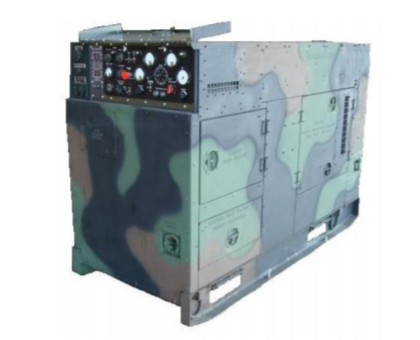
DLA Land and Maritime is requesting proposals for supply of two diesel engine parts kits. These kits are to maintain the 30KWB 805B / 806B and 815B /816B diesel generators.
The solicitation includes two national stock numbers with a maximum contract value of $1.8 Million. DLA projects annual demand quantity as follows:
The Defense Logistics Agency is seeking 5 to 20 structural panels for the KC-135 aircraft. The request for proposal was issued on June 10 with responses due on July 10.
This solicitation is designated 100% small business set-aside.
The awardee will receive a five year Indefinite Quantity Contract (IDC). DLA estimates they will need 20 units per year, but are only obligated to purchase a minimum of 5 units. Intended sources include:
Nordham Group (cage 29957)
Handy Tool & Mfg (91750)
Honeycomb Co of America (99115)
Craft Mfg (0CMM5)
Other small businesses are welcome to submit proposals, although source approval is required. You can learn more about these companies including other items they have sold by logging into BidLink.
Technical data is available on the Boeing designed aluminum panel.
To see detail on this solicitation, log into BidLink and put SPE4A720R0759 into “Search for Anything” at the top of the screen.
A solicitation was issued on June 4 for 29 parts kits for guns to be delivered to Warner Robins Air Force Base. Recent procurement history indicates a price of $6,822 per kit for a total contract value of $197,838.
The kit includes:
Self-locking nuts
Machine screws
Shear bolts
Shims
Spring pins
Machine screws
Retaining rings
Lock washers
Entrance unit
drum unit
Price quotes are due by June 15. For a complete parts list including National Stock Numbers and quoting details, go to BidLink.net
We’ve found another way to get the beta.sam solicitations into BidLink while they fix their feed. You will see the new SAM results in your searches if they match.
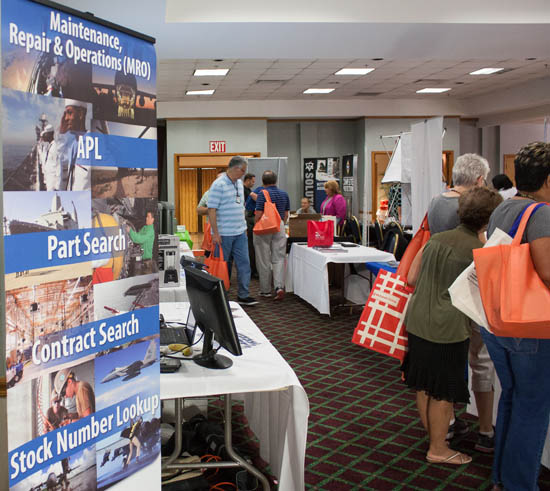
Government sponsored trade shows are B2G events that bring together buyers and sellers. On the surface, it sounds like a great idea to increase competition for Government business. However, many companies are finding that the leads generated from these shows do not turn into business.
B2G shows are often packed with buyers, who process requisitions from managers and end users. Their job is to solicit items and services, ensure competition where possible, and make sure the procurement adheres to the FAR. Buyers can invite new companies into a procurement, but they do not decide what products and services are needed by the Government.
SPY PHONE BOX
At a recent trade show, the booth next to us at BidLink was a company selling a secret spy-phone signal blocking box, for top secret conference rooms. It was basically a cone-of-silence for cell phones, with radio signal blocking, sound deadening and speakers that generate white noise. Secret agents could put their phones in the box, close it, and have private conversation without the prying ears of spies. People in secret meetings can honestly say, “Honey, the phone never rang. I swear”. It was a great idea, that will never gain traction at the typical B2G show. This is because buyers, the most common attendees at B2G shows are not the folks who would make a decision that the Government needs a few secret spy-phone blocking boxes. Program managers and other higher-ups have this authority, but it’s simply not the buyer’s job to decide what the Government needs.
A few booths down, there was a company selling industrial supplies. He had a catalog of over 10,000 items; everything from generators, to wash buckets, to paint, to industrial toilet paper. B2G Shows are perfect for this type of company. Drive around any military base and you will see hosing units, stores offices, and lots of people. These people need every day things, and the Government buys lots of them. A vendor selling commonly purchased items could forge a new relationship with many buyers at a B2G show. Especially if they are 8a or small business. Buyers love to bolster their set asides.
BETTER NETWORKING
We see lots of companies selling IT solutions at these shows. They sell innovative solutions to Government problems, including staffing, supply chain, and even BidLink, who provides a tool for sourcing, pricing, and finding out almost anything about an NSN. These services do not have a clearly defined market in the Military, but they provide efficiency that could save the Government money and time.
If you are trying to introduce something new to the Government, you may find it difficult to get any traction from a Government trade show. This is because most of the attendees at these shows are either buyers, who only buy items that are requisitioned, or end users with no buying authority. We have met with very few program managers at these shows. Program managers have the authority to decide if a new product or service could be of use to their group.
The idea of getting business and Government together make sense. Companies have difficulty reaching the right contacts in Government, so hosting meetups is a great idea. The disconnect is that sometimes these shows are filled with people who alone, cannot make the decision to buy your new product or service.
What might improve these trade shows would be for program managers as well as several of their personnel to attend the show together. Often the program manager might not directly use the product or service, but has the authority to decide if it should be purchased. Program managers roaming a trade show with a couple of end users, who can evaluate the service would provide a powerful combination. Combining the need to buy (end user) with the purchasing authority (program manager) allows companies with new ideas for the Government to showcase their wares to folks who may actually buy what they offer.
BidLink.net is a provider of defense industry information for contractors worldwide. This data includes millions of defense contracts, procurement history, part numbers and vendor details. This unique combination of resources allows BidLink to monitor and extract important information for the defense contracting industry. BidLink.net, based in Washington, D.C., provides bid search and notification services, competition analysis as well as part number (NSN) lookup to many military activities and thousands of private companies around the world.
For the news and tools to compete in the defense industry, go to www.bidlink.net.
WC-130J Hercules aircraft weather reconnaissance loadmaster. DoD photo by Staff Sgt. Manuel J. Martinez, U.S. Air Force. (Released)
By Tom Gerbe – Defense Information Analyst – BidLink.net
Small businesses have an uphill battle when trying to compete with big companies for defense contracts. Government officials know that small business participation not only helps local economies, but increases competition therefore reducing costs for the military. Undersecretary of Defense, Dr. Ashton Carter recently stated that, “Real competition is the single most powerful tool available to the department to drive productivity”. A number of initiatives are in place to promote “Real Competition”.
Twelve memoranda have been issued over the last three years from the president on down, outlining rules and methods for increasing competition in defense contracting. All of this is designed to deliver better value to the taxpayer and warfighter by improving the way the department does business. At a time when all departments are cutting expenses to reduce the deficit, program managers throughout DOD have a real motivation to act on these initiatives.
PROMOTE REAL COMPETITION
The following are recommendations from Dr. Ashton Carter on how to promote competition:
Present a competitive strategy at each program milestone
Remove obstacles to competition
Allow a reasonable time to bid
Require non-certified cost and pricing data on single offers
Require open system architectures and set rules for acquisition of technical data
Increase dynamic small business role in defense marketplace
Government buyers have a responsibility to promote competition wherever possible. If you know the rules, they can be convinced to un-bundle contracts, consider alternative suppliers and even set-aside contracts exclusively for small business. The key is understanding the Federal Acquisition Regulations (FAR) and how they can be used to benefit your company.
BUNDLED CONTRACTS
In some cases, your company may produce a part which is often included in larger, long-term contracts. The Small Business Reauthorization Act of 1997 defines contract bundling as “consolidating two or more procurement requirements for goods or services previously provided or performed under separate, smaller contracts into a solicitation of offers for a single contract that is unlikely to be suitable for award to a small business concern.”
The act requires that each federal agency, to the maximum extent practicable:
structure contracting requirements to facilitate competition by and among small business concerns, taking all reasonable steps to eliminate obstacles to their participation; and
avoid unnecessary and unjustified bundling of contract requirements that may preclude small business participation in procurements as prime contractors.
In some cases, requirements are bundled together for years even though buyers are supposed to re-evaluate the market on a periodic basis. At the time of the initial requirement by the Government there may have been only one supplier for a part, while years later a number of small business may be able to compete. As a potential bidder on a contract, it is your responsibility to advise the buyer that you would like to compete for this business. If you are successful, buyers may un-bundle a long-term contract for many items and solicit them separately in order to promote more small business competition. The Government is required to justify contract bundling and this justification can be challenged by a prospective bidder.
COMPETITION ADVOCATE
When all else fails, each program provides a competition advocate. According to FAR 6.502 Competition advocates are responsible for promoting the acquisition of commercial items, promoting full and open competition, challenging requirements that are not stated in terms of functions to be performed. They are also responsible for challenging barriers to the acquisition of commercial items and full and open competition such as unnecessarily restrictive statements of work, unnecessarily detailed specifications, and unnecessarily burdensome contract clauses. A memorandum from the Office of the Undersecretary of Defense states a commitment to, “Reinvigorate and expand the role of the competition advocate and reinforce the importance of competition to everyone involved in the acquisition process”.
We encourage you to study the Federal Acquisition Regulations and learn your rights as a contractor. Many initiatives have been put in place to help small contractors compete. Understanding the rules is the first step toward bringing Government business to your business.
BidLink.net is a provider of defense industry information for contractors worldwide. This data includes millions of defense contracts, procurement history, part numbers and vendor details. This unique combination of resources allows BidLink to monitor and extract important information for the defense contracting industry. BidLink.net, based in Washington, D.C., provides bid search and notification services, competition analysis as well as part number (NSN) lookup to many military activities and thousands of private companies around the world.
For the news and tools to compete in the defense industry, go to www.bidlink.net.
Air Force Capt. Bachelor – a KC-10 Extender aircraft pilot
by Tom Gerbe – Defense Information Analyst – BidLink.net
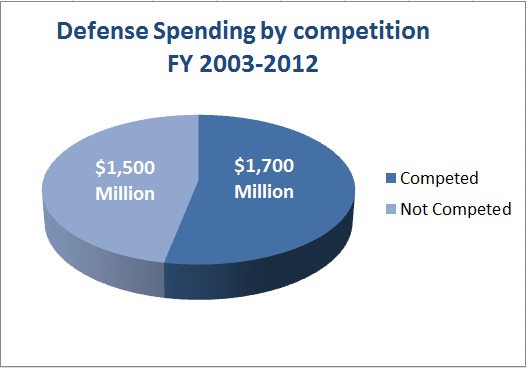
With the fiscal cliff rapidly approaching, defense contractors will need to become more competitive as defense budgets shrink. BidLink recently analyzed defense spending by competition from 2003-2012 and discovered that almost half of the contracts awarded from the Defense Department were not competed.
Defense Spending by competition FY 2003-2012
This pattern varied by industry with makers of large systems including aircraft dominating markets, while manufacturers of clothing, refrigeration equipment and replacement parts experience a more competitive environment.
Competitive initiatives taking hold
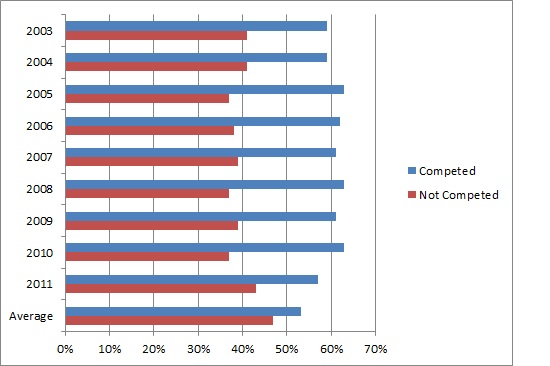
The Defense Department is committed to increasing competition by delivering more contracts to small businesses.
Percentage of competition for defense contracts by year 2003-2012
One of our readers responded to an article commenting, “I know much more, but if I could just win some of these contracts we would be golden”. The fastener industry is competitive. Recently, we added a tally of number of competitors to our contract award display at BidLink, which is yielding some interesting results. An analysis of defense contracts awarded to the fastener industry over the last few years reveals a high number of competitors, even for some relatively small contracts.
Stud, shouldered and stepped
The highest number of competitors for a fastener contract in 2011 was for contract no. SPM5A211M2084, where forty one (41) companies submitted bids. The contract was only valued at $10,270 and was awarded to Quality Socket Screw Corporation (cage code: 5N116) for 2,600 steel studs. The winning price was $3.95ea. Quality Socket Screw Corporation in Englewood, FL has 22 registered NSNs with the Defense Department and have received over 9,000 contracts and delivery orders.
LONG TERM CONTRACTS
There were twenty two (22) competitors for SPM5AY10D0113, a long-term contract awarded to Columbia Nut and Bolt (cage code: 51792) on 9/30/2010. The contract covers 29 stock numbers for studs, close tolerance screws, self-locking nuts and quick release pins. Several delivery orders against this contract are for large quantities of self-locking nuts, NSN 5310-01-011-3085. The Defense Department has ordered over 185,000 of these against this contract for $1.13ea. That’s over $200,000 in sales on this one part. Columbia Nut and Bolt has $20 million in annual sales with 700 employees.
The key to winning these contracts is knowing the competition by using online resources to research before you bid. Start by exploring existing contracts to see who is winning and at what price. The Government is moving away from small orders and toward the use of long-term contracts to streamline the process of procurement. In stead of issuing an RFQ for each order, they are consolidating many requirements into a single contract, then issuing delivery orders against that contract. The window of opportunity for competitors is when these contracts expire. The contract above expires on 9/29/2012.
Knowing when these contracts expire, the winning price, and how many competitors are participating can put you in a good position to compete for the next award. Also, the Defense Department is required to award a certain percentage of contracts to small businesses. The target for 2011 was 23%, or $12 Billion in small business awards. Each contract is designated as small business or large business.
If a contract is for small business, companies below a certain size (usually < 500 employees) will get certain advantages. If a small business and large business are competing and offer the same price, the small business will likely win the contract. Solicitations can be re-classified as small business by contacting the the buyer who issued the contract, and proving that you can supply the parts. To learn more about small business set-asides, check out sba.gov. Of course, you can always search BidLink for contracts that are small-business set-aside.
BidLink.net is a provider of defense industry information for contractors worldwide. This data includes millions of defense contracts, procurement history, part numbers and vendor details. This unique combination of resources allows BidLink to monitor and extract important information for the defense contracting industry. BidLink.net, based in Washington, D.C., provides bid consolidation, searching and notification services, as well as part number (NSN) lookup to many military activities and thousands of private companies around the world.
Comments? Send them to news@bidlink.net.
This article was written exclusively for “Fastener Journal” magazine .
The defense department is about to enter an age of austerity like it hasn’t seen in decades. Even the downsizing of the Military during the Clinton years pales in comparison to the cuts that must be made to the defense budget in order to comply with the debt ceiling agreement. A twelve member committee has to find $1.8 trillion in cuts or a package of automatic cuts will go into effect that would total $1.8 trillion slashing medicare and defense spending equally. The defense department has to start cutting costs, and fast.
So why is the Government wasting so much money on sole source supply for parts that other companies can make. For example, from 2006 to present, the defense department purchased $1.6 Billion worth of fasteners (Federal Supply Classes 5305, 5306, 5307, 5310, 5325). Of this total, almost 1/3 ($440 million) was from contracts for which there is only one supplier. Of the 154,053 contracts issued within this period, 38,392 (25%) of these contracts were sole source. After further analysis, many of these parts are not specialized items, and may have Commercial Off The Shelf (C.O.T.S.) equivalents. In fact, the Government would prefer to purchase C.O.T.S. parts whenever available. The problem is that only one supplier has been approved to supply these parts.
This is the opposite of what the Defense Department is trying to encourage, which is greater competition. In February of 2010, the Defense Department issued an interim rule to increase competition in major defense acquisition programs, in an effort to trim defense spending. As a result, prime contractors are required to provide technical data packages that were once considered proprietary information, making it easier for smaller companies to produce the same goods. This is part of an ongoing initiative at the Defense Department to increase competition for sole source items. This initiative has only begun, and has a long way to go. Lots of small businesses would like to sell to the Government, but have difficulty finding drawings, technical characteristics, a sample or anything needed to compete with these large suppliers.
To make matters worse, some of these big suppliers try to further confuse competitors by providing part numbers to the military that are different than their similar off-the-shelf parts. A competitor attempting to acquire a sample from one of these companies may be told that the particular part is only sold to the military. If a company cannot acquire the part, then there is nothing to reverse engineer. One way to circumvent this strategy is to contact the buyer directly, or try to locate the supply depot that stores the item. BidLink’s procurement history tool can help companies locate this vital information.
Once a company wins a long-term sole source contract, they can just count the money. These contracts can last for years, and have thousands of delivery orders. A reliable flow of business that can help offset the weak consumer and commercial markets. The government evaluates sole source items and attempts to apply an estimate of what it would cost to acquire that item from a different source. This includes the cost of creating the required technical documentation as well as any implementation requirements.
Sole searching
Finding sole source contracts is easy. Our Procurement History tool searches 60 million contracts and line items, and can be refined by number of offers. For fastener companies, you could search the NSN database for something like FSC 5305 to locate stock numbers of interest, then submit these into the Procurement History tool with the “sole source” check box selected. This will display a list of all sole source contracts for the selected items. Look at the company details to see if they are a manufacturer or distributor, and locate the buyer information. You can contact the buyer directly to get started.
A recent example was contract # SPM4AX-07-D-9007 which was awarded on 09-09-2011. The defense department ordered 10,000 units of NSN 5305-14-529-9082, a screw priced at $51.67 ea. In 2011, they have issued 8 delivery orders for this item, totalling $1.49 Million dollars. The sole vendor is Messier-Bugatti (CAGE code F6137). There is very little public information relating to this item or how to make it.
Sell to the suppliers
Many of these large suppliers, especially in the fastener industry are simply giant distributors who are experts in finding and winning defense contracts. Companies like Kampi and Columbia Nut and Bolt are good examples. Manufacturers can skip the government quagmire entirely by approaching distributors and selling to them. These companies are easy to locate by searching through procurement history and vendor databases.
BidLink.net is a provider of defense industry information for contractors worldwide. This data includes millions of defense contracts, procurement history, part numbers and vendor details. This unique combination of resources allows BidLink to monitor and extract important information for the defense contracting industry. BidLink.net, based in Washington, D.C., provides bid consolidation, searching and notification services, as well as part number (NSN) lookup to many military activities and thousands of private companies around the world.
Comments? Send them to news@bidlink.net.
This article was written exclusively for “Fastener Journal” magazine .